
Compliance and Safety in Commercial Medical Gas Systems for North Texas Buildings
Tips for DFW General Contractors
In the Dallas-Fort Worth healthcare market, compliance and safety are not just goals—they are the foundation of project viability. A single regulatory violation can delay occupancy by months, jeopardize CMS reimbursement, or trigger Joint Commission (TJC) findings that cost owners hundreds of thousands in lost revenue and remediation.
At IMSI Mechanical—a veteran-owned specialist in mission-critical medical gas—we help general contractors achieve zero-deficiency surveys on the first attempt. This guide outlines the 2026 compliance landscape, safety protocols, and integration strategies necessary for success in the demanding North Texas healthcare environment.
1. Understanding DFW and Texas Regulatory Requirements
The 2024 edition of NFPA 99 is the governing standard for all piped medical gas and vacuum systems in Texas. However, DFW contractors must also navigate specific state-level mandates:
- Licensing: The Texas State Board of Plumbing Examiners (TSBPE) requires all installers to hold a current Medical Gas Piping Installation Endorsement.
- Verification: For Category 1 systems (hospitals and surgery centers), an independent third-party ASSE 6030 Verifier must certify the system before any patient use.
- The 2024 Update: Enhanced standards now require stricter alarm monitoring and specific auxiliary connections on the patient side of source valves to allow for emergency hookups without system shutdowns.
2. Step-by-Step Compliance Checklist for DFW Contractors
Following this rigorous path has helped our partners pass every regulatory survey over the past 24 months:
- Credentialing: Verify TSBPE endorsements for all technicians before mobilization.
- Early Plan Review: Submit medical gas plans to the Texas Department of State Health Services (DSHS) and local AHJ at 50% design.
- Pre-Concealment Verification: Require ASSE 6030 third-party verification before closing any walls.
- Purity Documentation: Record particulates, moisture, and hydrocarbon levels for every zone.
- Standing Pressure Tests: Conduct 24-hour tests at 150 psig for positive pressure and 30 inHg for vacuum.
- Staff Training: Conduct hands-on training for clinical staff on zone isolation and emergency procedures 30 days before the facility opens.
- Handover Binder: Compile all certifications, purity reports, and Revit as-builts into a finalized compliance binder.
3. Key Safety Protocols for DFW Healthcare Projects
Safety in North Texas facilities like Baylor Scott & White or Texas Health Harris Methodist requires redundant protections against both mechanical failure and environmental hazards.
Medical Gas Room Standards
- Ventilation: All gas storage rooms must maintain a minimum of 1 cfm per square foot.
- Fire Rating: Enclosures must have a minimum 2-hour fire-rated construction.
- Seismic Anchoring: Given the soil volatility in DFW, all manifolds and bulk tanks must be seismically anchored to prevent line shears during structural settling.
Emergency Access and Visibility
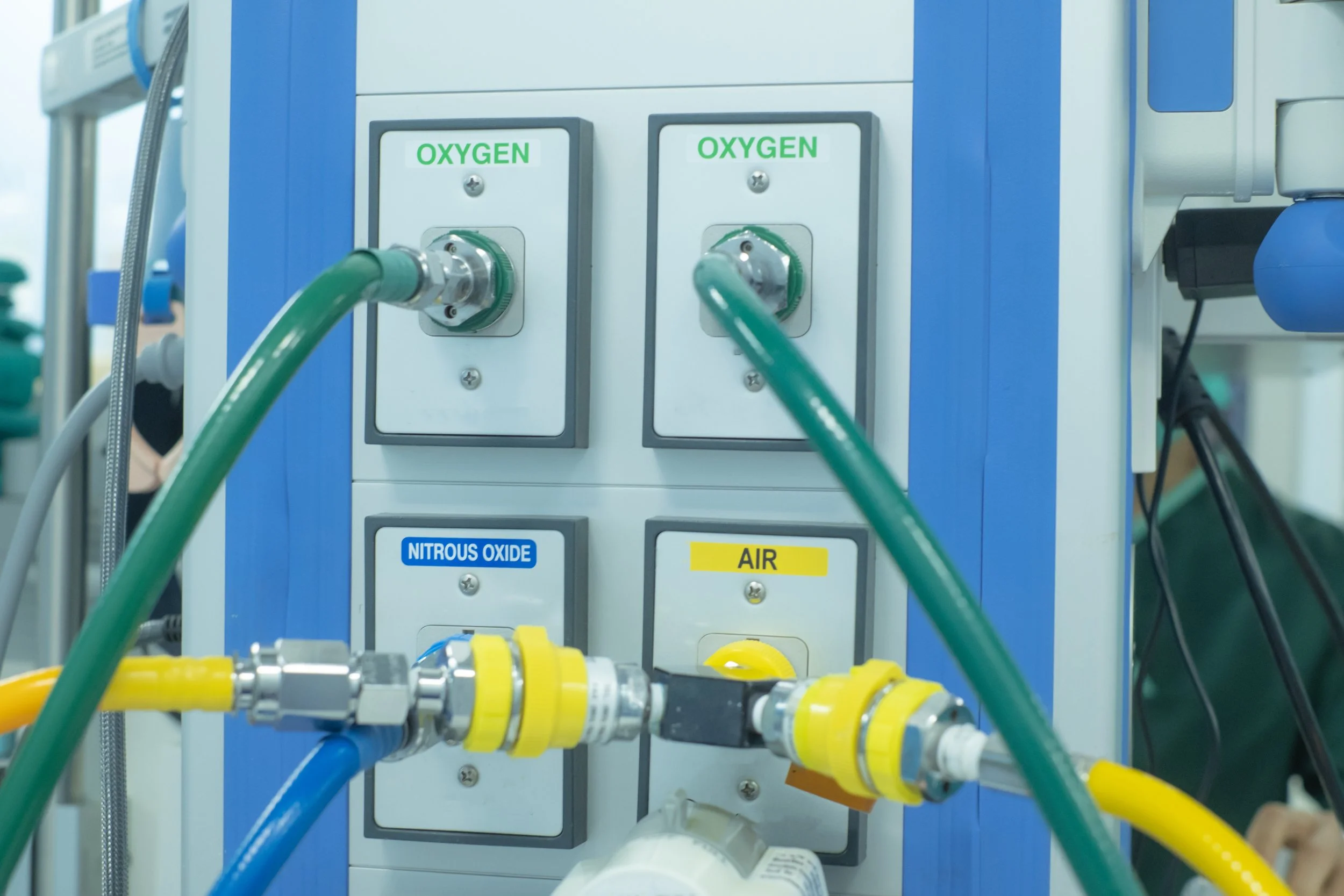
- Zone Valve Boxes (ZVB): Install ZVBs with clear window indicators and standardized color-coding (Green for Oxygen, Blue for Nitrous, Yellow for Medical Air).
- Auxiliary Connections: As per the 2024 NFPA 99 update, we install auxiliary cylinder connections on the patient side of every source valve. This allows clinicians to attach portable tanks directly to a zone if the main supply is compromised.
4. Integration Strategies: HVAC, Plumbing, and Electrical
Medical gas systems cannot exist in a silo. Proper integration is essential for both safety and energy efficiency.
- Cross-Contamination Prevention: Medical gas lines must never share trenches with sanitary lines. We utilize BIM Level 300 to ensure dedicated "clean" corridors for all gas piping.
- HVAC Coordination: We coordinate with the HVAC team to ensure positive-pressure environments (minimum 0.01 in. w.c.) in operating rooms are maintained while medical gas outlets are being tested.
- Building Automation (BAS): Integrate all master and area alarms with the BAS. This allows for centralized monitoring and automatic text/email alerts to facilities teams if pressure fluctuations occur in Plano or Arlington ambulatory centers.
5. Rebates, Incentives, and Documentation
Efficiency in medical gas is often overlooked but highly rewarded.
- Equipment Rebates: Oncor offers rebates for energy-efficient medical air compressors and vacuum pumps—often up to $0.18 per kWh saved.
- The Compliance Binder: IMSI Mechanical prepares a "Survey-Ready" binder. This comprehensive documentation makes Joint Commission and DSHS surveys fast and smooth, reducing the administrative burden on the general contractor.
6. Overcoming Common Compliance Challenges
- Infection Control (ICRA): For occupied renovations in Dallas or Fort Worth, we implement ICRA Level IV barriers and utilize temporary cylinder banks to ensure zero interruption to patient care.
- Lead Times: High-purity fittings and alarm panels currently face 120-day lead times. We mitigate this by placing orders during the 30% design phase.
- Performance-Based Contracts: We offer contracting options where a portion of our fee is tied to the successful, first-time passage of the third-party verification and state survey.
Conclusion: Lead with Compliance
In the competitive DFW healthcare market, your reputation is built on the safety of the systems you deliver. Partnering with a specialist who understands the 2026 regulatory landscape ensures your project is not only compliant but built for long-term operational excellence.
Ready to ensure a zero-deficiency survey for your next project? Contact us for compliance planning, ASSE-certified installation, and third-party verification support.